KMAK · 20.18 · The Work Bench · essay ·
A Tad Out of My Price Range
A watch I adored, the sun and moon crossing a sky, and the gears behind the dome.
One day in October I saw a watch and fell in love. Van Cleef & Arpels, the Midnight Jour Nuit Phase de Lune: a sun and a moon that rise and set behind a little hill, and a moon that goes through its phases, on a wristwatch that sells for $153,000. I wrote to Claude that $150K was just a tad out of my price range, so I wanted to build one. By midnight the same day I built one on the screen, with a real gear train under the dome. This is the story of that day. I had a lot of fun.
Three rotations
I wanted VCA's idea and I wanted it big. A desk piece, something between a mantel clock and an orrery, with the mechanism hidden behind the dome and a button to make the dome see-through so friends can get lost in the gears. The more complex and steampunk the better. Correct by day and time when it starts, and a full cycle button that runs one whole month for fun, from today's phase back round to today's phase.
Claude's first answer was a departure from the watch, and I took it. VCA's sun and moon ride one disc that turns once a day, and a month-long run on that disc would wheel the sun past thirty times. So my build has three rotations instead of two: a sun ring, a moon ring, and a moon that is a ball turning on its own axis once a month, half bright and half dark. The phases come from the ball turning. The details are in the addendum.
On the screen
The build started as a simulator, one web page, the dial drawn on a canvas. By the afternoon it had the sun crossing by day, the moon by night, a crown you drag to scrub time and four small buttons that step it by six or twelve hours. Then a full cycle, then the shroud going translucent to show a crude train behind it. It was wonderful. I had them slow the full cycle to about half as fast.
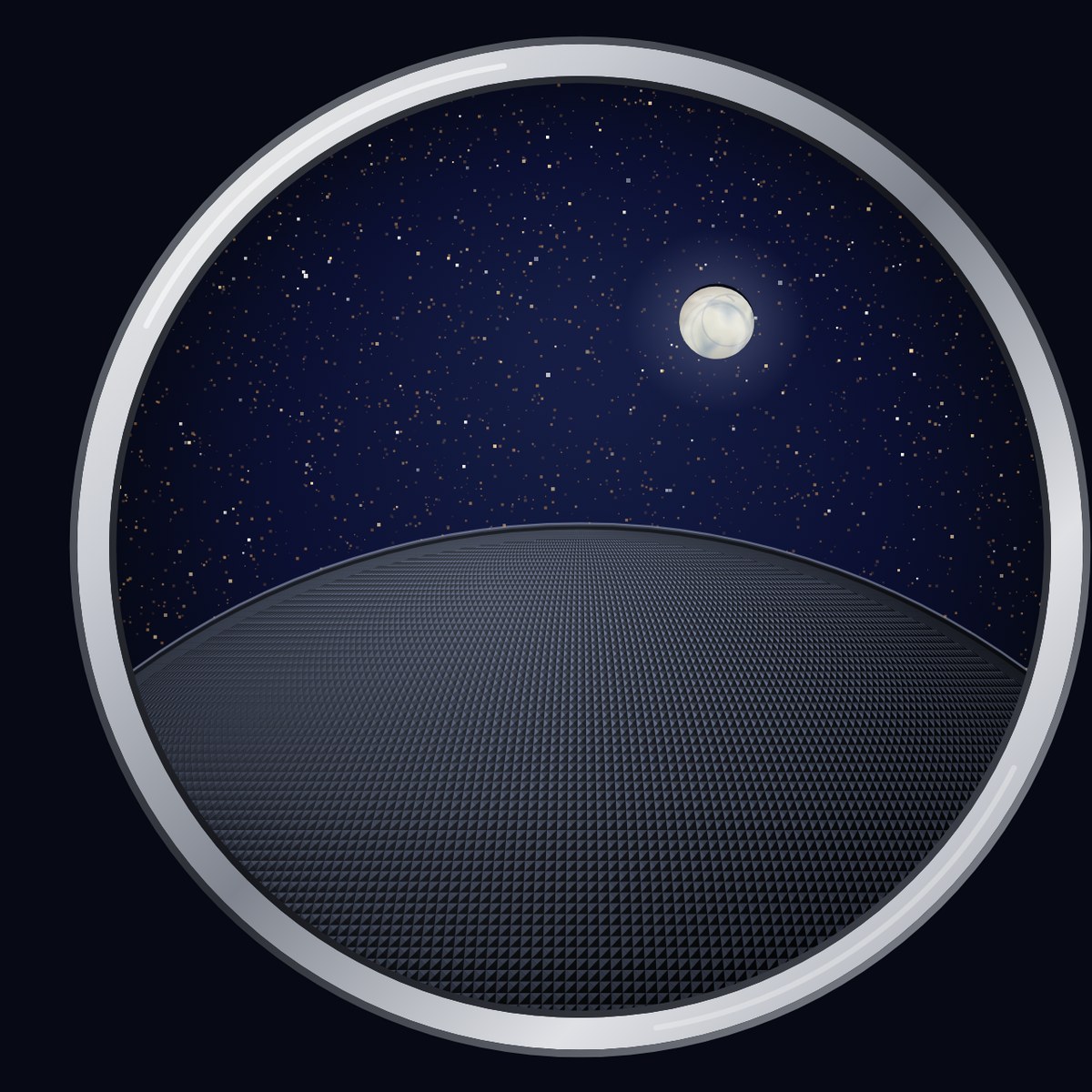
Around sunset I swam for half an hour, longer than I usually do, and spent the whole swim thinking about it. What I came back with was the idea that the full screen should be the finished object, with the Van Cleef treatment: a dark aventurine sky with the stars out all day, a sun like a gold rosette, a moon of white nacre, a studded silver dome, the name embossed in the brass behind it. The page keeps its buttons, and the full screen shows the piece on its own.
Then I checked whether the gears were realistically designed. They weren't. They were drawn to look busy. So I specified a real gear train, and that evening the simulator got one, every tooth counted and every mesh checked.
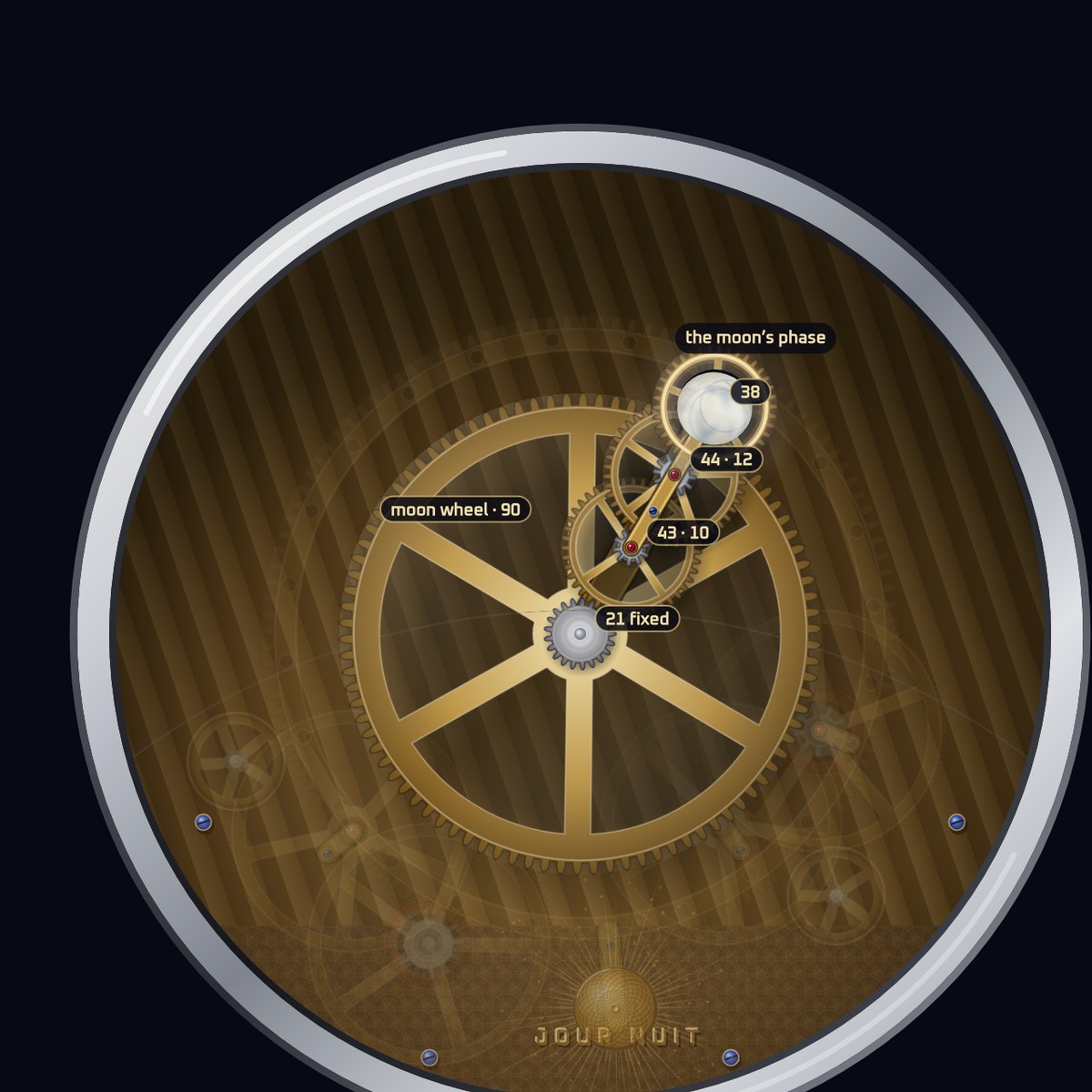
The part I like best is the moon's phase. There's no motor in that chain. A wheel fixed at the centre, a planet rolling round it on the moon's arm, and two more pairs behind it turn the ball once a month, with a day of drift every 180 years. The two rings have a motor each, geared down so far that a flywheel on each motor shaft, which Claude calls the heart, is always visibly turning. I wondered whether a gemstone is ever used in gears, learned that watchmakers run pivots in synthetic ruby, and added the jewels.
One hour
The full cycle needed a pace. I wanted two: the machine's own, and a fast one. The machine's own pace is a lunar month in one hour, like an hourglass.
Fast is a second motor behind the back plate, with a clutch on each ring. Press fast and the clutches engage, the fast motor takes over, and on the page you can watch the hearts and the middle wheels stop while the rings race. The month finishes in about a minute. Release, and the steppers carry on where the clutches left them.
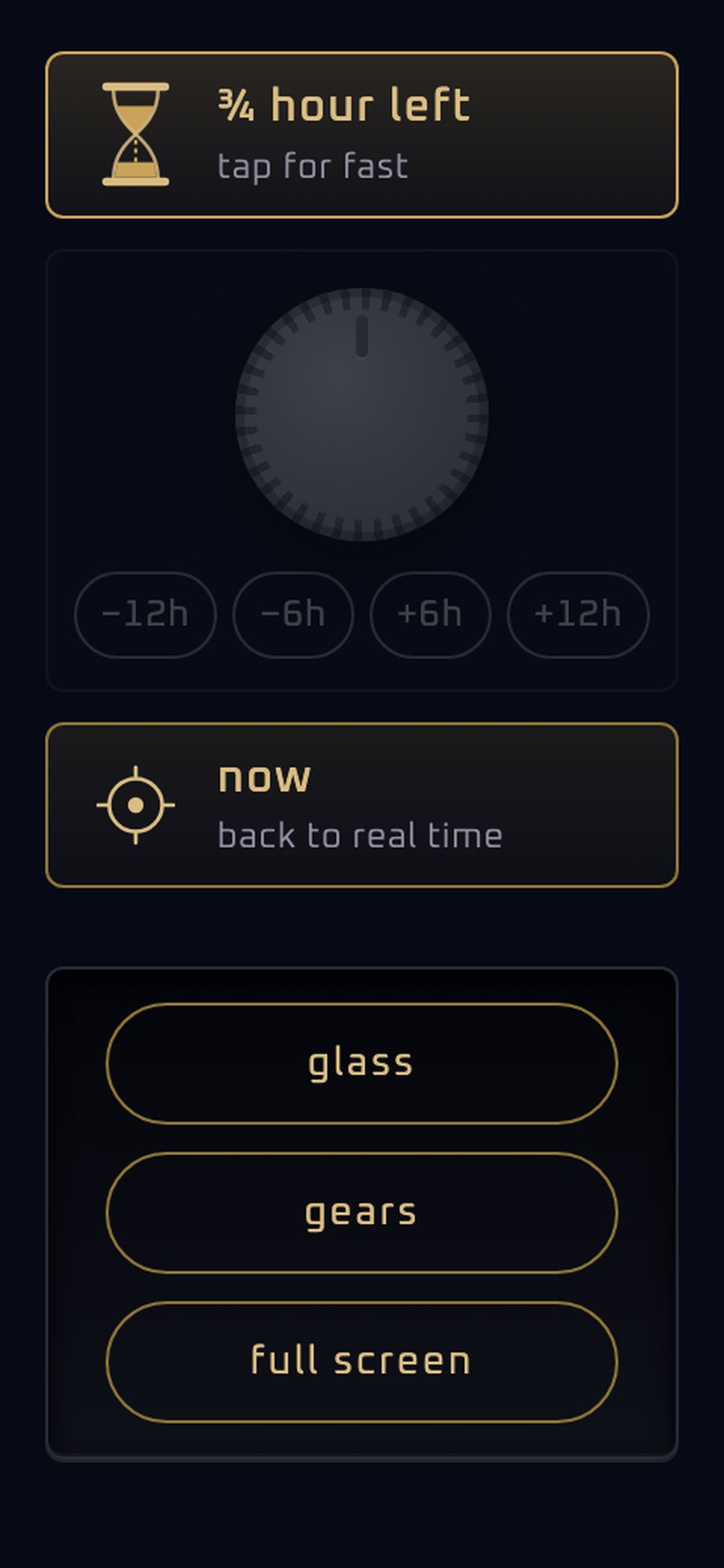
Later the full cycle got its own control, an hourglass on a card at the top of the column. Press it and the hourglass turns over, the sand starts to fall, and the label counts down in quarter hours. While it runs, the crown and the step buttons grey out, and the Now card lights up to take you back to real time.
Aldo's questions
My husband Aldo had a look and asked whether all those gears were necessary. After the real gear train was installed I could confidently say yes, but showing it was complex, so the Gears button was born. It opens the shrouds on the whole movement, with a button for each of the five gear chains. Pick one and it lights up with its tooth counts, the part of the sky it moves, and a few sentences on why it exists. Pick the fast chain during a fast run and you can see which wheels have stopped. Yes, they're all necessary, and now I can show anyone why.
His second question was why the sun and moon weren't sitting on the gears they ride on. That settled something I'd been avoiding: they're mounted on the rings, so they go where the rings go. Now they set behind the dome with their gears, and when you open the dome they're down there, riding round on the brass. I'm glad he asked.
Where it stands
It's finished and lives at /jour-nuit/, on this station. It keeps real time for Cloverdale, with real sunrise and sunset, and the stars out all day, because they are there and I want the eye on the sun and the moon. Press the hourglass for the hour. Press Glass to see through the dome, Gears to open everything, Full Screen for the piece on its own.
The machine itself is still a drawing. The gear train is designed and checked, every mesh exact, and it's drawn at a scale I could cut from brass. The motors, the clutches, the plates that hold it all and the small differential inside the moon are listed below as things to decide. Yay, It Moves took a weekend of hardware. This One Works has been waiting since June for a printer. This one has a real train on paper and nothing on the bench. I can't wait.
Addendum: the mechanism
For anyone who wants the numbers. The train was laid out in millimetres for a 45 cm dial and checked by a script that runs the simulator's own motion against the tooth counts.
Three rotations. VCA puts the sun and moon on opposite sides of one disc that turns once a day, which is why their watch needs a pusher to show you the moon in the daytime. Here a sun ring turns once a day. A moon ring turns once per lunar day, twenty-four hours and fifty minutes, so the moon rises about fifty minutes later each night, as it does in the sky. The moon is a ball geared off the moon ring, turning on its own axis once a synodic month, 29.53 days. The moon is up in the daytime near new moon and up all night at full, which is true, and at new moon the dark ball crosses in front of the sun.
The moon's phase. A 21-tooth wheel is fixed at the centre. The moon ring carries an arm round it, and on the arm a 43-tooth planet rolls on the fixed wheel and turns. Two more pairs, 44 driven by 10 and 38 driven by 12, slow that down: 43/21 × 44/10 × 38/12 = 28.530 to one, against a target of 28.531 (the month minus the arm's own turn). The error is fifteen parts per million, one day every 180 years. The phase is right because it's geared to the moon's own motion.
The drives. Each ring has a stepper motor and a 1,440 to one reduction: a pinion of ten into a wheel of 120, twice over, then a final pinion into the ring, 12 into 120 for the sun and 9 into 90 for the moon. At that ratio the motor turns about once a minute while the rings keep real time. A small motor on the moon's arm turns the ball's cradle through 12 into 64 so the lit side faces the sun, fed through a slip ring at the centre. Every arbor with a front pivot turns in a synthetic ruby.
The hour. A lunar month in one hour is 2.853 degrees a second at the moon ring, so the moon's stepper runs at about 685 turns a minute through its 1,440 to one. That is near the edge of what a small stepper will do, and the number is in the spec as something to check before buying a motor.
Fast. One small gearmotor behind the back plate drives both rings through a timing belt and two electromagnetic clutches on the final arbors. Pulleys of 57 and 59 teeth hold the sun and moon at their true ratio, 29.53 turns to 28.53, to within 37 parts per million; the steppers take up the difference when the clutches release. The month finishes in about a minute.
Addendum: what isn't decided
For the real build, four things are open, in the order I'll meet them.
- The fast motor and the clutches. The belt and the 57 and 59 tooth pulleys are designed. The motor and the two electromagnetic clutches are not chosen, and the clutch size sets how much of the mechanism they have to spin.
- The cradle's differential. The moon's cradle turns so the lit side faces the sun, and turning the cradle would also turn the ball and throw the phase off. A small bevel differential inside the moon cancels that. The idea is settled. Its tooth counts are not, and it isn't drawn.
- Plates, bridges and pillars. The simulator draws the cocks for the first wheels and the bridge for the moon arm. The frame that holds everything else, front plate, back plate, pillars, is still to design.
- The stepper. The moon's motor runs at about 685 turns a minute during the hour-long cycle. A common NEMA 17 will do that with less torque than it has at rest, so the motor is chosen by its torque at that speed.
Sources: the design brief and gear spec written during the October 23, 2026 session (Developer/Jour Nuit), and the session itself. Quotations are from the session, lightly punctuated. The gear train was laid out and checked by Claude; the ratios above are from that check.
Related: Yay, It Moves, the rover that was this bench's first program, and This One Works, the speakers still waiting for their printer.